
The Goldbach Conjecture
Dive into the tantalizing tale of the Goldbach Conjecture, a centuries-old mystery that has revolutionised number theory, yet eluded proof. From Goldbach's letters to Euler to groundbreaking modern advances, this article explores the enigma of “expressing every even number as the sum of two primes”. The greatest minds in the world couldn't solve it, can you?
Abhay L Kashyap
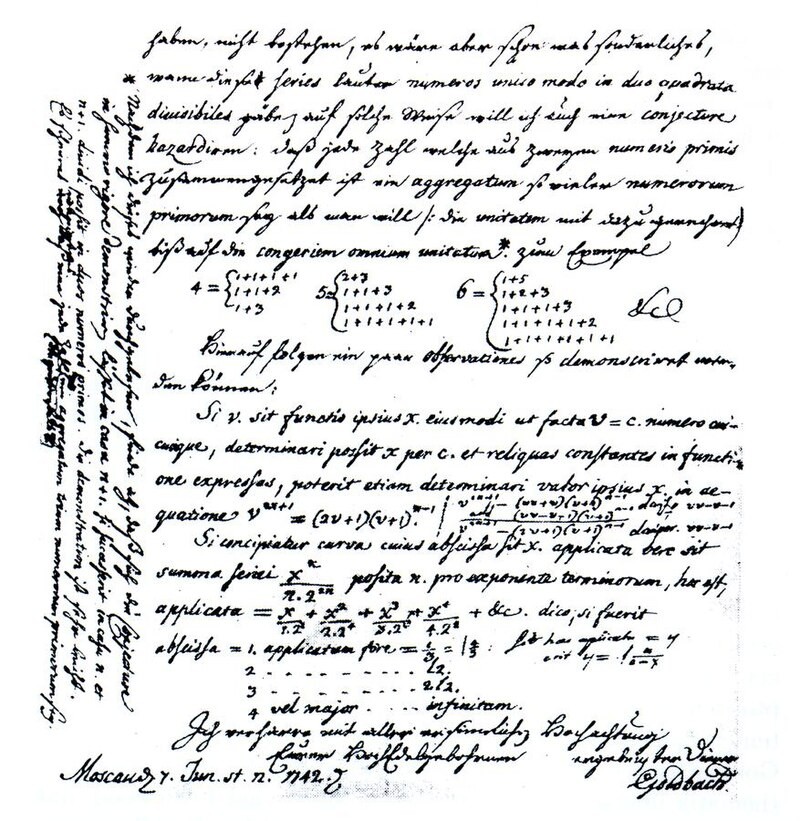
In the realm of number theory, the Goldbach Conjecture stands as an enigma that has captivated mathematicians for centuries. Proposed by the Prussian mathematician Christian Goldbach in a letter to Euler in 1742, the conjecture posits a seemingly simple yet elusive idea: that every even integer greater than 2 can be expressed as the sum of two prime numbers. Despite its apparent simplicity, this conjecture has resisted numerous attempts at proof. In this article, we will delve into the history and the current state of the Goldbach Conjecture, one of the oldest unsolved problems in mathematics.
Christian Goldbach was a mathematician primarily focused on the field of Number Theory. He famously maintained a correspondence with Leonhard Euler. Following is a recreation of one such exchange.
Goldbach: Any integer expressible as the sum of two prime numbers can also be represented as the sum of an arbitrary number of primes, continuing until all the terms in the sum are equal to one. Also, every number that is greater than 2 is a sum of three prime numbers.
Euler: That is quite interesting. I must note that your second statement is equivalent to something you had written to me about before, “Every even integer is the sum of two primes.” I consider that... every even number is a sum of two prime numbers, which is a completely certain theorem, even though I cannot demonstrate the same.
Let us first translate these statements into the modern convention of not considering 1 to be prime. Then the statements in order would be:
Any integer expressible as a sum of two primes can be represented as the sum of an arbitrary number of primes, continuing until all the terms in the sum are equal to 2, in the case of an even integer, or one of them is 3, in the case of an odd integer.
Every integer greater than 5 is the sum of three prime numbers.
Every even integer greater than 2 is the sum of two prime numbers.
Here, it is evident that the second and third statements are equivalent. Let us try to prove this.
Firstly, assume that every even integer greater than 2 is the sum of two primes.
Then, 2, 4, 6, 8,..., 2n,... can all be written as the sum of 2 primes.
Now, choose an integer N greater than 5.
If N is even,
It can be written as the sum of two primes.
Also, N-2, being an even number greater than 2, can be written as the sum of two primes.
Let those primes be p1 and p2.
Then, N = p1 + p2 + 2.
Thus, N is the sum of 3 primes.
If N is odd,
N-3 is an even number greater than 2.
Then, N-3 can be written as the sum of two primes. Let those primes be p1 and p2.
Then, N = p1 + p2 + 3.
Thus, by strong induction, N is the sum of 3 primes.
Thus, every N greater than 5 is the sum of 3 primes.
Now, to prove that the first statement follows from these statements, it is a little trickier, but here we go.
Choose an integer N expressible as the sum of 2 primes. The smallest such numbers are 4(=2+2) and 5(=2+3), where the statement already holds.
If N is even and greater than 4,
It can be written as (N-2) + 2, where (N-2) is an even integer greater than 2.
Thus, by the third statement, (N-2) can be expressed as the sum of two primes, p1 and p2.
Then, N = p1 + p2 + 2, where N is the sum of 3 primes.
If N is greater than 6, it can be written as (N-4) + 2 + 2, where (N-4) is an even integer greater than 2.
Following the same principle as above, N can be written as the sum of arbitrarily many primes until all the terms are 2.
If N is odd and greater than 5,
It can be written as (N-3) + 3, where (N-3) is an even integer greater than 2.
As we have established, the even integer (N-3) can be written as the sum of arbitrarily many primes until all terms are 2.
Thus, N, too, can be written as the sum of arbitrarily many primes until all terms are 2 and one term is 3.
Thus, the first statement holds.
Now, if Euler proclaims something as a “completely certain theorem,” it is quite difficult to disagree with him. However, maths does require rigorous and precise proof to formally declare a theorem as completely certain. Mathematicians have spent decades trying to prove what Euler could not. Although considerable progress has been made, both the strong and weak Goldbach conjectures remain unproven. We will now go over some of the closest results that have been arrived at.
In 1930, Lev Schnirelmann introduced a principle that would prove to be instrumental in solving the conjecture. He was able to prove that any integer greater than 1 can be expressed as a sum of less than 800,000 prime numbers using this principle. Other mathematicians refined and optimised it to get smaller and smaller constraints. Currently, the best result we have is that every positive integer greater than 1 is the sum of less than or equal to 6 prime numbers, which is incredible.
Vinogradov's method, developed by Ivan Vinogradov in the 1930s, is a powerful analytical tool in number theory, particularly for tackling problems related to additive number theory. Nikolai Chudakov, Johannes van der Corput, and Theodor Estermann made contributions within the framework of Vinogradov's method and managed to prove that almost all even positive numbers are sums of two primes using Vinogradov's method.
With advancements in computational technology, we have been able to check Number Theory results for very large numbers. Tomas Silva and Zig Herzog, among others on the internet, have made the biggest contributions to the computational results of the Goldbach conjecture. In 2005, it was checked for all integers less than 3*10^17 and double-checked for all less than 10^17. By 2012, it was checked for all integers less than 4×10^18 and by 2013, it was double-checked for all less than 4×10^17. Many interesting and convincing heuristic arguments have also been made in support of the conjecture.
In conclusion, the assertion that every even integer can be expressed as the sum of two prime numbers is not only captivating but also woven into a compelling historical narrative. Even though it is widely believed, it has eluded proof despite attempts by the world’s greatest mathematicians. The Holy Grail of the Goldbach conjecture has inspired the development of ingenious mathematical techniques and has become a symbol of the enduring challenges and mysteries that persist in the world of mathematical inquiry and the perseverance of humans. Perhaps one of the readers can take the last step to prove the conjecture or, more interestingly, disprove it!