Mathematics and the Ire of Dogma
Stendhal once said “Mathematics allows for no hypocrisy and no vagueness.”
Kavin Narayanan

Stendhal once said “Mathematics allows for no hypocrisy and no vagueness.”
The above statement may sound ridiculously obvious, and an absolute fact today. However, this was not the case in many of the rather bleaker periods of human history. Mathematics as a field of inquiry and study has certainly not existed in a vacuum throughout the memory of “Science-fearing civilization.”It has always been subject to the ups and downs of the other less scientific, social structures and ideologies. This whole paragraph might have sounded like a random sophisticated word salad, but that’s just to pique your interest, dear reader. I’m sorry if I sound like a “Bourgois academician.” (You’ll get the pun later). Now, before you punch me in the face, let’s dive into each and every step of this brutal waltz between mathematics and politics.
From time immemorial, Mathematicians and scientists have always tried to stay as far as they can from the “lesser” affairs of polity, public affairs, and superstition. They have constantly stayed in pursuit of some arbitrary truth which continues to evade them. In their pursuit, however, humanity benefits from the many great by-products of their journey. Sometimes, they are pulled into the gruesome world they were trying to avoid. Take Archimedes, for instance(Yup, the Eureka guy), who was killed by a cultist Roman soldier(Definitely not for running naked and traumatizing his countrymen) for making circles, which was seen to be a symbol of the “dark arts.”
Let’s also consider the bastions of modern mathematics, i.e., Germany and Russia.
Russia
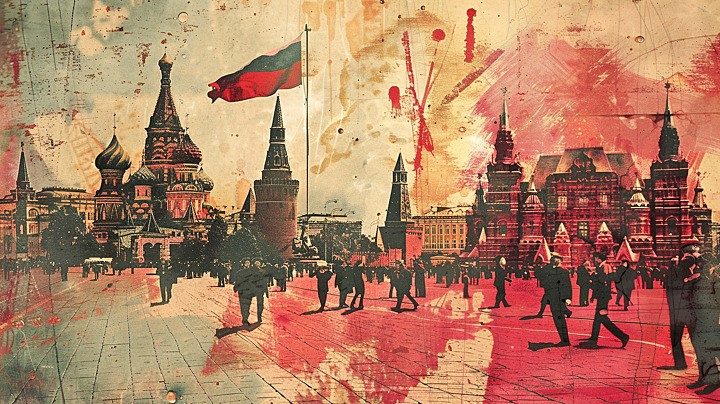
Under Josef Stalin's regime, the Soviet government promoted a version of materialism that emphasized the application of Marxist-Leninist principles to scientific inquiry. This philosophical stance, known as "mathematical materialism," sought to apply the dialectical and historical materialist framework to mathematics. In essence, it proposed that mathematical theories and concepts should be developed with consideration of their practical, material applications and alignment with Marxist-Leninist ideology. This approach was part of a broader push to align scientific disciplines with the goals of socialism and communism. The Soviet leadership believed that science should directly serve the interests of the state and contribute to the building of socialism. As such, mathematical materialism was encouraged to support practical applications in industry, engineering, and technology, aligning mathematical research with the needs of the state and its economic plans.
At the same time, Stalin's regime enforced severe restrictions on theoretical mathematics, particularly on areas that were perceived as abstract or not directly useful for the state's immediate goals. This crackdown was part of a larger trend of ideological control over the sciences.
One notable example was the denunciation of certain mathematical theories that did not fit the regime's criteria for practical utility or ideological alignment. The work of many mathematicians, especially those engaged in pure or abstract mathematics, came under scrutiny. These mathematicians often faced criticism, suppression, or even persecution if their work was deemed too far removed from the practical and ideological goals of the state. The most infamous instance of this crackdown was the attack on the work of Soviet mathematician Andrey Kolmogorov, whose contributions to probability theory and turbulence were initially considered suspicious. Although Kolmogorov himself managed to navigate this turbulent period and maintain his position, the broader climate of repression had a chilling effect on the development of theoretical mathematics.
The impact of Stalin's policies on mathematics was multifaceted. On the one hand, there was significant progress in applied areas of mathematics that aligned with state interests, such as statistics, optimization, and engineering mathematics. On the other hand, the restrictions on theoretical mathematics stifled creativity and led to a narrowing of research interests. Many mathematicians found themselves constrained by the ideological and practical requirements imposed by the regime. Overall, Stalin's encouragement of mathematical materialism and the crackdown on theoretical mathematics exemplify the broader tensions between scientific inquiry and political ideology. The emphasis on practical applications and ideological conformity often came at the expense of scientific freedom and the pursuit of fundamental knowledge.
Germany
Under the Nazi regime, the landscape of mathematics in Germany was profoundly disrupted by the intersection of political and racial ideologies with academic pursuits. The Nazis' racial policies had immediate and far-reaching effects on the mathematical community, starting with the expulsion of Jewish mathematicians. These scholars, who had made significant contributions to various mathematical fields, were systematically removed from their academic positions. This purge included prominent figures such as David Hilbert, who, despite his age and stature, was subjected to scrutiny due to his Jewish heritage. The broader impact was devastating: the German mathematical community lost many leading minds, which not only weakened ongoing research but also stunted intellectual progress within the country. The forced emigration of these mathematicians often meant that their work continued to flourish elsewhere, contributing to the global advancement of mathematics, but Germany's own research landscape suffered as a result.
In addition to the racial purges, the Nazi regime promoted the notion of "Aryan science," which claimed that scientific and mathematical achievements should be aligned with Nazi ideology and reflect the racial superiority of Aryan scientists. This approach led to an environment whe re academic work was evaluated not on its intellectual merit but on its adherence to ideological and racial criteria. Mathematical research that did not conform to these ideological standards was marginalized or suppressed, creating a climate of fear and self-censorship among scholars. This ideological rigidity not only stifled creativity but also redirected research efforts away from pure mathematics and theoretical work that was deemed less practical or ideologically aligned.
All in all, the effect that the mindset of the people(both institutions and individuals) adversely affects the free spirited-ness of any field of enquiry. However, I urge you not to make the mistake of thinking that the worst is behind us; even today, there is repulsiveness and disdain towards several modern sciences in places like sub-Saharan Africa and South America. It is paramount to overcome these hurdles and make mathematics a buffer zone where people from all walks of life can come and search for the universal truth together.