
The Equation of Team Success
Mathematics fuels team success by unlocking the power of data, strategy, and innovation. This article journeys through game theory, AI-driven insights, and optimization models to reveal how numbers transform tactics on fields and in boardrooms. From predicting penalty kicks to perfecting corporate strategies, it celebrates the synergy of human intuition and analytical precision.
Akarsh Dubey
Game Theory: Predicting the Next Move
Game theory's fascinating approach goes beyond academia and becomes a practical tool for anticipating competitive moves. Imagine a soccer goalkeeper analyzing data to predict where the penalty taker will aim or business negotiators using these principles to balance collaboration with competition.At its core lies the payoff matrix, a tool that lays out potential outcomes based on choices made by competing players. Nash equilibrium, another cornerstone of game theory, comes into play when teams seek strategies where no participant can benefit by unilaterally changing their approach—a balance that’s crucial in both sports and corporate negotiations. It’s all about staying one step ahead by reading the game—or the market—like a seasoned strategist.
Data Analytics: Finding Stories in the Numbers
Gone are the days of relying purely on gut feelings. Data analytics has revolutionized how teams evaluate performance by transforming raw datasets into meaningful insights. In basketball, advanced metrics like effective field goal percentage (eFG%) use weighted averages to combine shooting accuracy from two-point and three-point ranges, offering a clearer measure of efficiency. These calculations hinge on statistical models that account for player tendencies, defensive pressure, and shot locations. Similarly, businesses apply regression analysis and clustering algorithms to track project progress, identify bottlenecks, and optimize resource allocation. By grounding decisions in quantitative analysis, teams maximize their strategic potential.
Optimization Models: Efficiency at Its Best
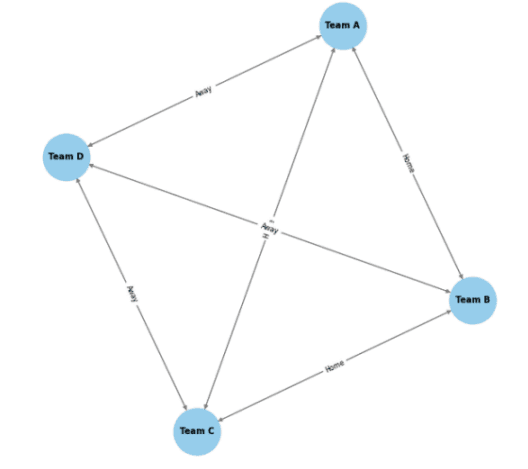
Ever thought about how sports leagues figure out game schedules that don’t leave teams exhausted from constant travel? Or how businesses manage to keep operations running smoothly despite endless moving parts? That’s the magic of optimization models. These tools rely on methods like linear programming and heuristic algorithms to tackle complex logistical puzzles. Let’s take a simple example with four football teams: Team A, Team B, Team C, and Team D. If each team needs to play every other team twice (home and away), combinatorial optimization ensures that travel distances are minimized while maintaining fairness in rest periods. For instance, instead of scheduling Team A to travel cross-country multiple times in a row, the model could group nearby games together—Team A plays Team B and Team C in one trip, then hosts Team D at home. This approach balances travel costs with competitive integrity, saving resources and keeping players at their best. It’s math making life easier, whether it’s on the court or in the office.
Decision Trees: Simplifying the Complex
Ever feel like big decisions are just one giant puzzle? That’s where decision trees come in to save the day. Think of them as a flowchart for your choices. Each branch represents a decision, with its own risks, rewards, and probabilities. It’s like breaking a tough problem into bite-sized pieces—much easier to handle! In sports, coaches use decision trees to figure out when to make bold moves. For example, should the team go for that risky three-pointer or stick with a safer two-point shot? The tree lays out all the possible outcomes and their probabilities, making the decision-making process way clearer. In business, decision trees help answer big questions like, "Should we enter this new market?" or "Is this product launch worth it?" By calculating expected values or trimming unnecessary branches, we can turn complicated choices into manageable steps—all with the power of math! What makes mathematics so powerful is its ability to complement human intuition. By connecting raw data to strategic insights, it empowers teams to adapt, innovate, and thrive. In a world increasingly driven by data, those who embrace these tools will be the ones to lead the pack. Whether you’re a sports enthusiast, business leader, or curious thinker, understanding the math behind strategy can open new doors. It’s about seeing patterns, making smarter choices, and turning potential into success. Ready to unlock the power of mathematics in your team’s journey?